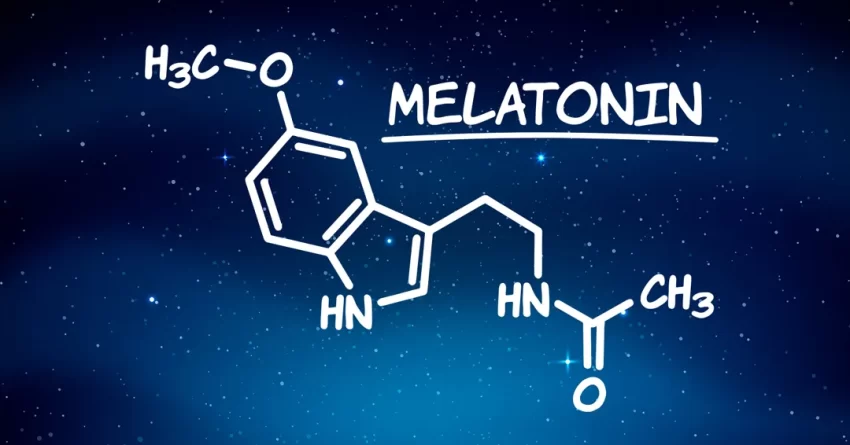
Why it matters: Melatonin, performance, and health
Melatonin is a biological "night" signal that synchronizes almost all of your internal clocks. It's not a sedative, but a signal that tells the brain it's time to slow down, promoting the onset of sleep and stabilizing the circadian rhythm.
When that rhythm is aligned:
- You fall asleep faster and with fewer awakenings.
- It enhances deep sleep quality, which is crucial for nervous system recovery and the pulsatile release of growth hormone.
- It improves insulin sensitivity, immune function, and mood.
For athletes and individuals who strength train, consistent sleep is a key multiplier for protein synthesis, tissue repair, and performance.
Beyond sleep
In addition to the essential role melatonin plays in sleep and circadian rhythm regulation, it is also a molecule with its own biological functions that act throughout the entire body, even outside the context of rest.
These actions contribute to cellular protection, the maintenance of mitochondrial function, and defense against processes that accelerate aging and tissue deterioration. Its main functions include:
- Potent antioxidant action and mitochondrial protection (it can cross membranes and act inside mitochondria).
- Anti-inflammatory action (modulates pro- and anti-inflammatory cytokines).
- Immunomodulatory effect (influences NK cells and T lymphocytes).
- Neuroprotection (reduces oxidative stress and neuronal excitotoxicity).
How it's produced (and what disrupts it)
Your pineal gland begins to release melatonin when ambient light decreases, signaling to your body that nighttime is approaching. This increase isn't immediate: it peaks approximately 2 to 3 hours before your natural bedtime, a time known as DLMO (Dim Light Melatonin Onset). From then on, the concentration remains high throughout the night and gradually decreases as dawn approaches.
However, several factors can reduce or delay this release, making it harder for you to fall asleep or diminishing its quality:
- Exposure to bright light at night, especially blue or white light from screens and LED lights, which tricks the brain into thinking it's still daytime.
- Stress and irregular schedules, such as very late dinners, intense evening workouts, travel across time zones, or shift work, which desynchronize the internal clock.
- Nighttime stimulants and depressants: caffeine (with a half-life of 5–7 hours), nicotine, and alcohol delay or reduce melatonin release and disrupt sleep architecture.
- Age: with age, endogenous melatonin production naturally tends to decline.
Pro tip: natural morning light (5–10 minutes in the sun or outdoors) and total darkness at night are the two most powerful regulators for keeping your endogenous melatonin levels high and stable.
Melatonin and post-workout recovery
- Sleep onset and consolidation: It shortens the time it takes to fall asleep (latency) and can increase sleep efficiency, promoting more stable and restorative cycles.
- Antioxidant and anti-inflammatory action: It neutralizes free radicals within mitochondria and modulates cytokine production, reducing the oxidative and inflammatory stress that follows intense workouts.
- Hormonal impact: By facilitating deep, high-quality sleep, it promotes optimal pulses of growth hormone (GH) and stability in the HPT/HPA axes, which indirectly contributes to maintaining healthy testosterone levels and thyroid function.
- Activation of parasympathetic tone: It promotes the “braking” of the sympathetic nervous system, allowing for better relaxation and recovery after demanding physical sessions.
Melatonin and muscle growth
Melatonin doesn't directly "build" muscle, but it does create the ideal physiological environment for training and nutrition to yield maximum results:
- More deep sleep → During deep sleep (N3 stage), the largest spike in growth hormone (GH) occurs, promoting an optimal environment for protein synthesis and the repair of damaged muscle fibers.
- Less residual inflammation and oxidative stress → You wake up with less soreness and stiffness, allowing you to train with better quality and consistency.
- Greater load and volume capacity → Quality sleep allows you to sustain higher workloads throughout the week, preventing chronic fatigue and reducing the risk of overtraining.
- Neuromuscular protection → It helps the central nervous system recover, maintaining strength and explosiveness between sessions.
Forms of supplementation
Immediate release (IR)
It is absorbed and reaches its peak blood concentration rapidly, with a half-life of approximately 30–60 minutes. It is ideal for facilitating sleep onset or advancing the circadian clock.
Delivery method: Choose sublingual (tablet or drops) → for direct absorption into the bloodstream, partially bypassing first-pass liver metabolism. Oral capsules and tablets work, but they take longer to act and have lower bioavailability.
Raw material purity and source: Look for labels on the bottle such as “USP grade,” “pharmaceutical grade,” or “99% pure melatonin.” It should be manufactured under GMP (Good Manufacturing Practices) or equivalent standards.
Clear and consistent dosage: The label should specify the exact dose per unit (e.g., “1 mg per tablet”) and confirm it has been lab-tested.
Third-party testing certification or seal: Look for NSF, USP Verified, Informed-Choice, or Labdoor Tested. This ensures the product contains what it claims and is free from contaminants.
Extended release (SR)
Designed to release melatonin steadily over 3–6 hours. It is useful for maintaining sleep in people who wake up in the middle of the night or experience fragmented sleep.
Sustained-release form: If you're looking for comprehensive support—help with both falling and staying asleep—choose a biphasic release formula. It combines an immediate-release portion with a sustained-release one that maintains stable melatonin levels for 4–6 hours, mimicking the natural nightly pattern.
If your only issue is staying asleep, a quality SR (Sustained Release) tablet can achieve a similar result for that function, although it won't have the rapid effect of the immediate-release phase.
In either case, the label should ideally specify the technology used and the estimated duration. Avoid products that just say “SR” or “time release” without further details, as they often release the dose too quickly or erratically. Look for dissolution tests that confirm gradual release over 4–6 hours. Additionally, the label should indicate a real matrix or coating (like HPMC or another polymer) and have purity certifications such as USP, GMP, or independent lab testing.
Practical Tip: Some people combine a small dose of immediate-release with a sustained-release (SR) dose to cover both sleep onset and maintenance.
Base dosage (less is more)
With melatonin, more doesn't necessarily mean more effective. For both immediate release (IR) and sustained release (SR), it's best to start low and adjust based on your response:
- Microdoses (0.3 to 1 mg) → First choice for most. In IR, it's usually enough to induce sleep without causing morning drowsiness; in SR, it helps maintain sleep without overwhelming the system.
- Standard dose (1 to 3 mg) → Useful for mild insomnia or periods of high stress. For IR, it facilitates faster sleep onset; for SR, it extends sleep stability for several hours.
- Specific cases (3 to 5 mg) → Recommended for jet lag, night shifts, or to adjust the circadian rhythm. Use only temporarily to prevent tolerance.
- More than 5 mg → Rarely necessary. This increases the risk of residual drowsiness, very vivid dreams, or disruption of the natural sleep pattern.
Tip: If you need help both falling and staying asleep, a biphasic formula with a moderate total dose is usually more effective than increasing the dose of a single-release formula.
Timing by goal
When you take melatonin is as important as the dose and format. Choosing the right type (IR, SR, or biphasic) optimizes its effectiveness and reduces the risk of unwanted drowsiness:
- To fall asleep → Sublingual IR (0.3 to 2 mg), 30–60 minutes before bed. Rapid absorption allows the blood peak to coincide with your natural sleep window.
- For nighttime awakenings → SR (1 to 2 mg), 60–90 minutes before sleep. It releases melatonin steadily over several hours to minimize interruptions.
- To fall asleep and stay asleep → Biphasic release (1 to 3 mg), 60–90 minutes before bed. It combines a rapid-release portion to initiate sleep and a sustained one to maintain it.
- To shift your circadian clock (advance your bedtime) → IR (0.3 to 1 mg), 4–6 hours before your usual bedtime. This sends a signal to the circadian system to advance its phase. Repeat for 5–7 days and combine with exposure to morning sunlight to reinforce the adjustment.
- Jet lag (eastward travel) → 0.5 to 3 mg (IR, SR, or biphasic depending on tolerance) at dusk in your destination, for 3–5 nights. Add morning light and avoid bright light late in the day to help advance your clock.
- Jet lag (westward travel) → 1 to 3 mg on the first and second nights, slightly later than usual. Seek afternoon light for the first few days to delay your clock.
- For night shifts → 1 to 3 mg (IR or biphasic) before your daytime "bedtime." Block light after leaving work with amber or red glasses and sleep in total darkness to reinforce the circadian signal.
Common mistakes
- Taking it too late → Taking it right as you get into bed, when you're already struggling to sleep, usually reduces its effectiveness. For tablets or capsules, allow a 60–90 minute window; for sublingual forms, take it about 30–45 minutes before bed.
- Using it as a daily crutch without improving habits → Taking it every night "just in case" without correcting light exposure, irregular schedules, or poor sleep hygiene limits its effectiveness and can lead to psychological dependence.
- Chronically overusing high doses → More isn't better. Continuously exceeding recommended doses increases the risk of residual drowsiness, vivid dreams, and psychological dependence, in addition to disrupting the natural pattern of endogenous melatonin production.
Enhancers: habits and synergies that make the difference
Melatonin doesn't work in a vacuum. Its effectiveness is multiplied when combined with habits and strategies that support natural production and sleep quality.
Light hygiene
- Morning: Expose yourself to natural light for 5–10 minutes right after waking up (longer if it's cloudy) to synchronize your biological clock.
- Night: Reduce light intensity and use warm-colored lights 2–3 hours before bed. If you use screens, use blue light filters or amber glasses to minimize the suppression of endogenous melatonin.
Routine
- Maintain a consistent sleep and wake schedule (within a ±60 minute window).
- Eat dinner 2–3 hours before bed, keeping it light on fats and alcohol-free.
- Avoid caffeine for 8–10 hours before sleep.
- Optimize your environment: a cool (17–19 °C / 63–66 °F), dark, and quiet room.
Nutritional synergies and supplements (optional)
- Magnesium glycinate: 200–400 mg, 1–2 hours before sleep, to promote muscle and nervous system relaxation.
- Apigenin (25–50 mg): useful if you find it hard to “shut off your brain” at the end of the day.
- Apigenin (25–50 mg): Useful if you struggle to “turn off your mind” at the end of the day.
- Avoid megadoses of antioxidants right after training if your goal is adaptation; take these nutrients at night, away from your workout window.
Safety, contraindications and interactions
In healthy adults, melatonin is safe when used at appropriate doses and times, especially in the short and medium term.
- Side effects: morning drowsiness, vivid dreams, headache, mild dizziness, or gastrointestinal discomfort. These typically improve by reducing the dose or adjusting the timing.
- Drug interactions: fluvoxamine (significantly increases its levels), anticoagulants like warfarin (increased risk of bleeding), immunosuppressants, antihypertensives (may lower blood pressure further).
- Substance interactions: alcohol and sedatives (cumulative sedative effect), caffeine and tobacco (accelerate its metabolism and reduce its effectiveness).
- Caution: pregnancy and breastfeeding (limited safety evidence), uncontrolled autoimmune disorders, epilepsy, severe depression, or any chronic medical condition. Always consult a healthcare professional before use.
- In children: Beyond the scope of this article. Requires diagnosis and medical supervision.
Conclusion
Melatonin is most effective when used strategically: dosages adjusted to needs, timing, and, above all, accompanied by good lighting hygiene and sleep habits. It can be a valuable tool for:
- Break out of streaks of poor rest and regain a stable pattern.
- Reset your internal clock during trips, shifts, or schedule changes.
- Maintain deep, restful sleep that boosts strength, muscle recovery, body composition, and overall health.